
About NIRAB
Nuclear Innovation Research Advisory Board (NIRAB)
NIRAB is an expert advisory board convened by NIRO to provide independent advice to Government, made up of a diverse range of individuals with broad interest and experience across all aspects of the nuclear fuel cycle as well as individuals who are experts in specialisms related to the sector.
Originally convened in January 2014, NIRAB has provided expert, independent advice on nuclear research and innovation to Government. The first NIRAB operated between 2014 and 2016, producing a report and recommendations that informed Government investment in the substantial Nuclear Innovation Programme (NIP). A second NIRAB membership and Chair operated from 2018-2020 with the work culminating in the report ‘Achieving Net Zero: The Role of Nuclear Energy in Decarbonisation’, the key recommendations of which are reflected in the ‘Energy White Paper: Powering our Net Zero Future, HMG, December 2020’ and accompanying ‘Ten Point Plan for a Green Industrial Revolution, HMG, December 2020’. The third NIRAB was convened in 2021 with the task to understand the RD&I required for AMR’s, in particular High Temperature Gas Reactors (HTGRs).
NIRAB Seeks Your Expert Advice: Call for Evidence
Call for Evidence: Recommendation 6 of the Nuclear Regulatory Review 2025
Call for Written Evidence and Expressions of Interest for Oral Evidence Sessions
The Government has established the Nuclear Innovation and Research Advisory Board (NIRAB) to provide independent advice on the implementation of Recommendation 6 of the Nuclear Regulatory Review 2025. Recommendation 6 concerns the definition and application of Tolerability of Risk (ToR) within the UK nuclear sector and the implications for regulatory decision-making, proportionality, innovation, delivery, and public confidence.
NIRAB is seeking evidence from organisations and individuals with relevant expertise and experience across the civil and defence nuclear sectors, as well as from comparable high-hazard industries.
Purpose of the Call for Evidence
NIRAB wishes to gather a broad range of views, evidence, data, lessons learned, and practical experience to inform its advice to Government. NIRAB is interested in understanding:
- Potential solutions and implementation approaches to establish a clear definition of tolerable nuclear risk.
- How tolerability of risk is currently interpreted and applied across the UK nuclear sector.
- The extent to which existing approaches support or hinder safe, proportionate, and efficient delivery.
- The relationship between risk tolerability, ALARP principles, and regulatory outcomes.
- International approaches and comparisons.
- The potential implications of changes to policy, guidance, regulatory practice, or governance arrangements.
- Barriers and opportunities relating to innovation, new nuclear technologies, decommissioning activities, defence programmes, and major infrastructure delivery.
Who We Want to Hear From
NIRAB welcomes evidence from, but not limited to:
- Regulators and Public Bodies
- Duty Holders and Industry Organisations
- Other Stakeholders including research institutions, professional bodies, representatives from other high hazard sectors and individuals with relevant experience and expertise
Written Evidence Submission
Written submissions should:
- Be no more than 10 pages in length.
- Clearly identify the organisation and contact details.
- Distinguish between evidence, opinion, and recommendation.
- Include supporting data, case studies, and references where available.
- Identify any information that is commercially sensitive or security-classified and should be treated accordingly.
NIRAB welcomes both technical submissions and strategic or operational perspectives.
Oral Evidence Sessions
NIRAB will also hold oral evidence hearings. Organisations wishing to provide oral evidence should submit an expression of interest outlining:
- The organisation represented.
- The proposed witness or witnesses.
- Relevant expertise and experience.
- The key issues they wish to address.
NIRAB aims to ensure balanced representation across regulators, duty holders, and other stakeholders.
Use of Evidence
Evidence received may be:
- Used to inform the NIRAB’s advice to Government.
- Referenced in the NIRAB’s final report.
- Shared with relevant Government departments and agencies.
- Published unless confidentiality is requested and agreed.
Respondents should clearly identify any material they consider confidential.
Closing Statement
NIRAB seeks evidence that is practical, evidence-based, and informed by operational experience. It is particularly interested in examples demonstrating how the current approach to tolerability of risk affects outcomes relating to safety, security, environmental protection, innovation, programme delivery, cost, and public confidence.
We encourage submissions from across the nuclear community and from comparable high-hazard sectors to support the development of balanced, proportionate, and effective advice to Government.
Please submit written evidence or an expression of interest to provide oral evidence to NIRAB@niro.org.uk.
Read more on the Taskforce Review here: Nuclear Regulatory Review 2025
NIRAB specific privacy policy here: Privacy Notice | Nuclear Innovation and Research Office (NIRO)
You can find more information on joining NIRAB here:
NIRAB’s Role?
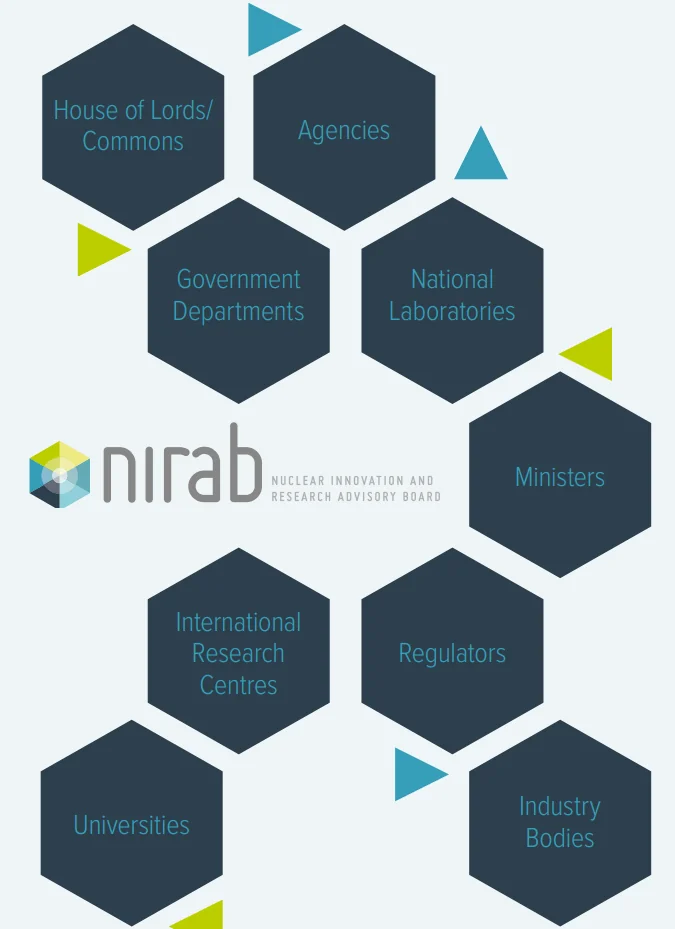
NIRAB works in partnership with NIRO to advise Ministers, Government Departments and Agencies on issues related to nuclear research and innovation in the UK. In particular to:
Monitoring and Advice
Monitoring the UK civil nuclear research and development landscape and providing advice to Government on areas requiring further investment or opportunities to optimise UK programmes.
Cost Reduction Strategies
Advise where research and innovation could drive down costs across the whole nuclear cycle.
Collaboration Opportunities
Identify opportunities for greater collaboration with industry and international partners.
Policy Support and Strategy Development
To support the development of recommendations for new research and innovation programmes and strategy required to underpin priority policies including clean energy, security, decommissioning, and non-energy uses of nuclear technology with a focus on delivering current policy objectives set out in the white paper on SMRs and Advanced nuclear technology.
Research and Innovation Landscape Review
To oversee a regular review of the nuclear research and innovation landscape which may include facilities, capability, portfolio and capacity in the UK.
Fostering Cooperation
To foster greater cooperation and coordination across the whole of the UK’s nuclear research and innovation capability, portfolio and capacity.
Programme Lifecycle Support
To provide support to UK nuclear programmes through their lifecycle and demonstration of new systems.
Further information
Membership of NIRAB
NIRAB draws on a wide range of expertise to offer informed advice on a range of issues, with members being the best in representing their fields. Members are appointed to provide advice and subject matter expertise independent from the interests of their employer. NIRAB also brings in advice from other experts as needed and is able to appoint additional members.
Members are invited to join NIRAB, for a period of three years with membership reviewed periodically beyond this point.
NIRAB Governance
NIRAB was formed in 2014 from the 2011 House of Lords Science and Technology Select Committee Inquiry into Nuclear Research and Development Capability. It is an expert-led advisory body convened by NIRO to provide independent advice and guidance. Members are appointed personally, independent of the organisation that they work for. With the exception of the Chair, appointments are unfunded, other than reimbursement of reasonable travel and subsistence costs. NIRAB does not have responsibility for managing or delivering any programmes of work or for directing or managing any budget.
Meetings
NIRAB meetings of a core strategic group will take place up to four times per year, with the option to have more if needed. These meetings may be virtual or in person depending upon need. Attendance at meetings is determined by the expertise needed to address specific issues on the agenda.
NIRAB may convene sub-groups to carry out specific workstreams as necessary. Meetings may include Observers such as Government and Departmental Chief Scientific Advisors, officials and representatives of public funding organisations including Research Councils, NDA, regulators, and Innovate UK, as appropriate.
By agreement with the NIRAB Chair, other participants may be invited to attend meetings as observers to provide support and information.
NIRAB Work
NIRAB’s work addresses specific issues and challenges facing Government and the UK nuclear sector, with the aim of fostering greater cooperation and coordination across the UK’s nuclear research and innovation capability.
NIRAB’s work involves monitoring the delivery and impact of the DESNZ Nuclear Innovation Programme and making recommendations.
NIRAB advises on matters such as innovation and identifying opportunities for collaboration.
NIRAB supports the development of recommendations for new research and innovation programmes and oversees a regular review of the nuclear research and innovation landscape.
Examples of areas of expertise
Implementation of research programmes to demonstrate new and novel nuclear systems.
- Expertise relevant to Advanced Nuclear
The potential for innovation to reduce the cost of the nuclear life cycle.
- Economics of nuclear
- Cross-sector experience of innovation
Opportunities for greater collaboration with industry and international partners.
- The UK nuclear industry landscape
- Cross-sector expertise
- Commercialisation of R&D
- The international nuclear arena
- Communication & Engagement
The impact and delivery of Government’s nuclear net-zero innovation programme.
- Nuclear fuel design and manufacture
- Manufacturing and materials
- Reactor design and operation
- Test reactor demonstration – design & deliver & programme delivery
- Construction technology (including modular and other novel methods)
- Waste management and decommissioning
- Modelling and simulation
- Nuclear regulation

Archived NIRAB Publications & Reports

NIRAB FAQ
NIRAB Role Description
NIRAB Annual Report 2020
NIRAB Annual Report 2022