
Civil Nuclear Landscape

A review of the civil nuclear R&D landscape is regularly undertaken to understand:
01
The amount of money spent on nuclear R&D and where the funding originates from.
02
Areas of focus for research activities.
03
The number of people employed in nuclear R&D.
04
Any geographical differences across the UK associated with major nuclear programmes.
05
Insight into the facilities used to undertake nuclear R&D.
06
The types of collaboration being undertaken to deliver nuclear R&D.
07
Organisations reflections and perspectives on the landscape, including current and enduring challenges.
08
Insight into the use of international facilities and collaborations/ partnerships with international organisations.
The latest landscape review was undertaken in 2024 which reviewed data from the financial year 2022/23. Any organisation, institution, company or body involved in nuclear R&D was invited to submit a response. The key findings from this landscape review are:
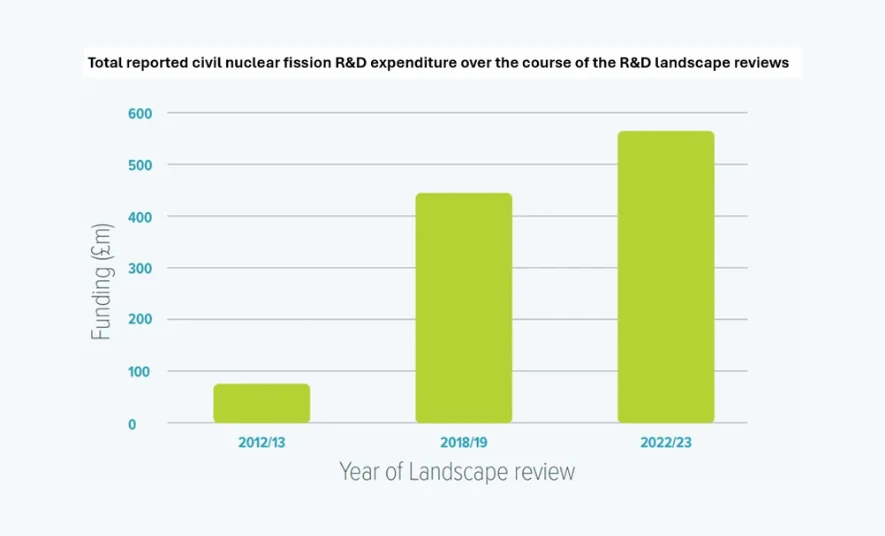
Total R&D funding has increased (with the majority of funding being provided by Government)
There has been a significant rise in total funding for nuclear R&D in the financial year 2022/2023 since the previous landscape study in 2018/2019. Funding has risen by 52% (after inflation) and stands at £570m (0.03% of UK GDP). Approximately £77m is from nuclear fusion activities (up from £54m in 2018/19) and £500m from nuclear fission (up from £140m in 2018/19). Over 1/5 of this annual spend is on Waste Management and Decommissioning activities associated with the Nuclear Decommissioning Authority (NDA) estate (£114m). Annual spend is in-line with other economies with significant nuclear programmes, but from a very low UK baseline of R&D spend in recent decades and against the backdrop of a significant need to scale up R&D capacity to support new nuclear ambitions. 7% of total R&D funding is leveraged from a combination of private sector and international sources, the remaining balance originates from Government sources.
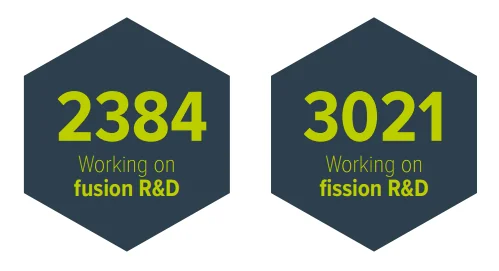
Significant R&D resourcing and staffing challenges in support of scaling-up wider sector capacity
This landscape analysis indicates that the sector has increased its R&D activity significantly over the last ten years. There are currently approximately 5405 full time equivalent (FTE) persons working on nuclear R&D in the UK. Work undertaken by the Nuclear Skills Strategy Group (NSSG) in 2022 to understand labour market requirements identified a significant challenge in resourcing new nuclear programmes whilst continuing to deliver existing programmes. In the context of a 24 GWe target, the total nuclear sector (civil and defence) is projected to need an increase of between 80% and 120% in labour capacity on top of replacing workers that retire. The R&D skills growth rate in 2022/23 does not meet the projected needs of an expanding nuclear sector.
UK researchers access a diverse array of facilities in order to conduct their research:
This landscape review revealed that during 2022/23 nuclear research was undertaken at over 50 international facilities and there was a heavy reliance on UK facilities accessed under the NNUF (National Nuclear User Facility) scheme. As a result of the ambiguity in future financing of the NNUF facilities and the reliance on access arrangements to international facilities, a case is beginning to form for new UK research provisions and more certainty on UK access/long-term funding arrangements to existing facilities.
Facilities, Equipment and Capabilities within the UK
Illustration of how the Facilities, Equipment and Capabilities are spread out across the UK demonstrating how nuclear fission R&D is being undertaken across the length and breadth of our shores.
Nearest Facility
Active Nano Mapping Facility
University of Bristol
Bristol
ADRIANA
Lancaster University
Lancaster
ADRIANA
University of Liverpool
Liverpool
ADRIANA
UKAEA CCFE
Abingdon
BUFF
Bangor University
Bangor
Centre for Radiochemistry Research
University of Manchester
Manchester
Dalton Cumbrian Facility
University of Manchester
West Cumbria
Diamond Active Materials Laboratory
Diamond Light Source
Didcot
EXACT
University of Southampton
Southampton
FaRMS
University of Bristol
Bristol
HADES
University of Sheffield
Sheffield
High Flux Accelerator-Driven Neutron Facility
University of Birmingham
Birmingham
High Temperature Facility
Jacobs
Warrington
Hot Robotics Facility, RACE
University of Manchester
Manchester
Hot Robotics Facility, RACE
Bristol
Bristol
Hot Robotics Facility, RACE
NNL
Workington
Hot Robotics Facility, RACE
UKAEA
Oxfordshire
Lancaster Accelerator Mass Spectrometer (LAMS-UK)
Lancaster University
Lancaster
Materials Research Facility
UKAEA
Culham
Molten Salts in Nuclear Technology Laboratory
University of Manchester
West Cumbria
MULTIForm
University of Leeds
Leeds
National Nuclear Laboratory
NNL
West Cumbria
National Nuclear Laboratory
NNL
Preston
National Nuclear Laboratory
NNL
Workington
Nuclear Materials Atom Probe (NuMAP)
University of Oxford
Oxford
PANAMA
University of Strathclyde
Glasgow
PLEIADES
University of Sheffield
Sheffield
Pyrochemical Research Laboratory
University of Edinburgh
Edinburgh
RADER
University of Manchester
Manchester
SIMFUEL and Alphas Active Materal Manufacturing and Characterisation Facility
University of Manchester
Manchester
UTGARD Laboratory
Lancaster University
Lancaster
Conclusions:
It is clear that the sector is calling out for key decisions to be made by Government to give a firm demand signal that a nuclear renaissance is going to be delivered within the timescales publicised. Understanding of R&D needs for future markets is maturing, but the stakeholders involved in this review strongly believe that the future science and engineering challenges are surmountable if funding is unlocked early and that there is firm long-timescale commitment.
Some people within the R&D sector feel that too much is currently left to market forces, rather than being driven by Government. Many responders want to see more strategic direction from Government either coordinated through its National Laboratories (e.g. NNL, UKAEA, NPL etc.) or from another centralised body.
From this review we know that the nuclear R&D sector is seeking:
Strategy and coordination of R&D activities:
The UK remains open to AMR, SMR, GWe scale reactors and other technologies to fill this capacity. Given the key role of Government funding in nuclear R&D, many would welcome greater clarity on which reactor types will be used to achieve 24GWe and where they will be sited as a clear programme will help drive private investment and regional economic growth.
Consistency of funding:
Many are concerned that the UK is entering a period of increased fiscal discipline, which could lead to reduced R&D budgets and a loss of momentum in the sector at a time where momentum is needed most. They desire a long-term plan that takes the nuclear sector to 2050.
Scaling up capacity (staffing):
R&D investment is one of the ways that the industry builds technical capability to lead programmes and projects. In increasing capacity, this review identifies a number of challenges that need to be addressed. These challenges are mainly in the University sector and include the ongoing need to attract young people into STEM subjects, and funding of nuclear Masters and PhDs. Respondents also point to the loss of expertise through retirement and lack of mechanisms to transfer knowledge from experienced researchers to Early Career staff. This is a key challenge in increasing capacity in the sector.
Less reliance on testing facilities overseas:
Many believe the UK needs its own Research Reactor/ Test Reactor/ Isotope Production Reactor to alleviate pressure on overseas facilities. Some respondents describe the additional benefits having such facilities would have, for instance in training and developing staff and in demonstrating a particular proof of concept.
Long-term access arrangements for NNUF:
Respondents to this review said that re-funding the National Nuclear User Facility (NNUF) access scheme is important in allowing researchers to access the facilities the UK has, to advance knowledge and understanding and to maximise the benefits from funding the equipment and facilities to date.
Post-Irradiation Examination (PIE) facilities:
A strategy to provide post-irradiation examination facilities in the medium to long-term is vital for underpinning future reactor and new fuel types.
Collaboration:
There are currently a number of collaborations between universities, industries and national laboratories in flight, both within the UK and overseas and there would be a benefit in strengthening some of these further to leverage the full economic value of funding available.
Funding and delivery are both fragmented, so part of the difficulty is having that holistic picture where there’s adequate coordination.
National Lab or Top Down Funder
There’s a need to have coordination across all the different areas of the sector i.e. between new nuclear and nuclear decommissioning and there’s not really a particularly great forum for that at the moment.
National Lab or Top Down Funder
International collaboration is more challenging. You need a mechanism to enable that collaboration. So, whether it's EURATOM or some mechanism that's doing that collaboration. It's been more difficult because of the whole BREXIT situation.
National Lab or Top Down Funder
The UK has such a wealth of historic knowledge which could be really valuable to future researchers. We need to ensure access to this knowledge is maintained and that people know where and how to access such information.
National Lab or Top Down Funder
We have got lots of advanced material and engineering challenges facing the sector over the next few decades but there's just not a full suite of facilities that exist in the UK to carry out all the research needed. If you look to the French model, it's very different. France does everything in-house and its research programme is half a billion Euros.
Industry
Our funding is so intermittent it’s hard to plan for the long-term. What we need is blocks of 5-10years of R&D funding sustained continuously over a 20+ year period.
Academic