
About NIRAB

Nuclear Innovation Research Advisory Board (NIRAB)

NIRAB is an expert advisory board convened by NIRO to provide independent advice to Government, made up of a diverse range of individuals with broad interest and experience across all aspects of the nuclear fuel cycle as well as individuals who are experts in specialisms related to the sector.

Originally convened in January 2014, NIRAB has provided expert, independent advice on nuclear research and innovation to Government. The first NIRAB operated between 2014 and 2016, producing a report and recommendations that informed Government investment in the substantial Nuclear Innovation Programme (NIP). A second NIRAB membership and Chair operated from 2018-2020 with the work culminating in the report ‘Achieving Net Zero: The Role of Nuclear Energy in Decarbonisation’, the key recommendations of which are reflected in the ‘Energy White Paper: Powering our Net Zero Future, HMG, December 2020’ and accompanying ‘Ten Point Plan for a Green Industrial Revolution, HMG, December 2020’. The third NIRAB was convened in 2021 with the task to understand the RD&I required for AMR’s, in particular High Temperature Gas Reactors (HTGRs).

A fourth NIRAB has not yet been convened.

NIRAB’s Role?

NIRAB works in partnership with NIRO to advise Ministers, Government Departments and Agencies on issues related to nuclear research and innovation in the UK. In particular to:

Monitoring and Advice

Monitoring the UK civil nuclear research and development landscape and providing advice to Government on areas requiring further investment or opportunities to optimise UK programmes.

Cost Reduction Strategies

Advise where research and innovation could drive down costs across the whole nuclear cycle.

Collaboration Opportunities

Identify opportunities for greater collaboration with industry and international partners.

Policy Support and Strategy Development

To support the development of recommendations for new research and innovation programmes and strategy required to underpin priority policies including clean energy, security, decommissioning, and non-energy uses of nuclear technology with a focus on delivering current policy objectives set out in the white paper on SMRs and Advanced nuclear technology.

Research and Innovation Landscape Review

To oversee a regular review of the nuclear research and innovation landscape which may include facilities, capability, portfolio and capacity in the UK.

Fostering Cooperation

To foster greater cooperation and coordination across the whole of the UK’s nuclear research and innovation capability, portfolio and capacity.

Programme Lifecycle Support

To provide support to UK nuclear programmes through their lifecycle and demonstration of new systems.
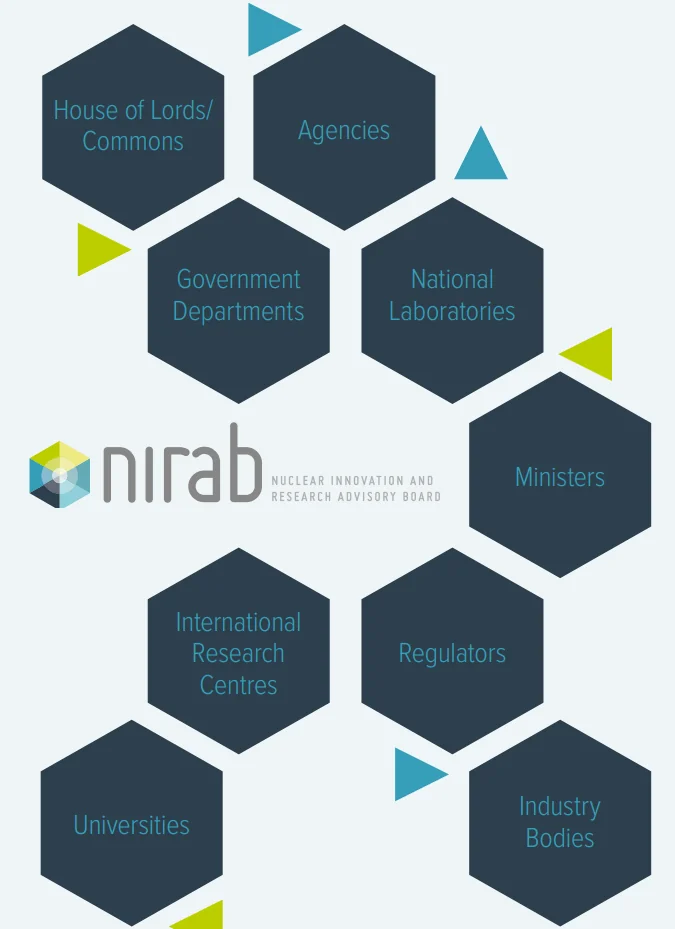
NIRAB is supported in its preparation of advice and guidance by the Nuclear Innovation and Research Office (NIRO). 

Further information

Membership of NIRAB

NIRAB draws on a wide range of expertise to offer informed advice on a range of issues, with members being the best in representing their fields. Members are appointed to provide advice and subject matter expertise independent from the interests of their employer.  NIRAB also brings in advice from other experts as needed and is able to appoint additional members.

Members are invited to join NIRAB, for a period of three years with membership reviewed periodically beyond this point.


NIRAB Governance

NIRAB was formed in 2014 from the 2011 House of Lords Science and Technology Select Committee Inquiry into Nuclear Research and Development Capability. It is an expert-led advisory body convened by NIRO to provide independent advice and guidance. Members are appointed personally, independent of the organisation that they work for. With the exception of the Chair, appointments are unfunded, other than reimbursement of reasonable travel and subsistence costs. NIRAB does not have responsibility for managing or delivering any programmes of work or for directing or managing any budget.

Meetings

NIRAB meetings of a core strategic group will take place up to four times per year, with the option to have more if needed. These meetings may be virtual or in person depending upon need. Attendance at meetings is determined by the expertise needed to address specific issues on the agenda.

NIRAB may convene sub-groups to carry out specific workstreams as necessary. Meetings may include Observers such as Government and Departmental Chief Scientific Advisors, officials and representatives of public funding organisations including Research Councils, NDA, regulators, and Innovate UK, as appropriate.

By agreement with the NIRAB Chair, other participants may be invited to attend meetings as observers to provide support and information.


NIRAB Work

NIRAB’s work addresses specific issues and challenges facing Government and the UK nuclear sector, with the aim of fostering greater cooperation and coordination across the UK’s nuclear research and innovation capability.

NIRAB’s work involves monitoring the delivery and impact of the DESNZ Nuclear Innovation Programme and making recommendations.

NIRAB advises on matters such as innovation and identifying opportunities for collaboration.

NIRAB supports the development of recommendations for new research and innovation programmes and oversees a regular review of the nuclear research and innovation landscape.


Examples of areas of expertise

Implementation of research programmes to demonstrate new and novel nuclear systems.

  • Expertise relevant to Advanced Nuclear

The potential for innovation to reduce the 
cost of the nuclear life cycle.

  • Economics of nuclear
  • Cross-sector experience of innovation

Opportunities for greater collaboration with 
industry and international partners.

  • The UK nuclear industry landscape
  • Cross-sector expertise
  • Commercialisation of R&D
  • The international nuclear arena
  • Communication & Engagement

The impact and delivery of Government’s nuclear
net-zero innovation programme.

  • Nuclear fuel design and manufacture
  • Manufacturing and materials
  • Reactor design and operation
  • Test reactor demonstration – design & deliver & programme delivery
  • Construction technology (including modular and other novel methods)
  • Waste management and decommissioning
  • Modelling and simulation
  • Nuclear regulation

NIRAB Members Archive

Discover past NIRAB board members

Learn more

Archived NIRAB Publications & Reports

Post Icon

NIRAB Annual Report 2020

This report provides a summary of the activity of NIRAB since April 2018, reflecting the progress made by NIRAB in formulating advice to Government on the future role of new nuclear energy as a means to achieve net zero by 2050 and in doing so create positive economic impact and jobs. A number of recommendations for action have been made.
More Information Download Document
Post Icon

NIRAB Annual Report 2022

This report provides an overview of the work of NIRAB over the year to October 2022 – three key areas of work were identified: Technology, Delivery, and Use Case. The focus of the NIRAB Technology Working Group (NTWG) was to advise on research and development needs for new nuclear, with a focus on (Advanced Modular Reactors) AMRs. The Delivery Working Group (NDWG) focused on innovations in delivery methodology needed to bring forward AMRs, and in particular High Temperature Gas Reactors (HTGRs) to build a demonstrator by early 2030’s. The Use Case Working Group (NUCWG) focused on the potential end user...
More Information Download Document
Post Icon

Research, Development and Innovation required for a High Temperature Gas Reactor Demonstrator

In this report NIRAB tackles the question “What Research, Development and Innovation (RD&I) is needed for the UK to deliver a High Temperature Gas Reactor (HTGR) Demonstrator by the early 2030s?”. To answer this NIRAB has interpreted the question as meaning the Demonstrator reactor should couple electricity production with high heat output, to be utilised in industrial applications. Hence, five key areas have been identified as needing investment and RD&I has been categorised as either  ‘essential’, ‘highly valuable’ or ‘valuable’. The report also covers the several industrial sectors in the UK which could be assisted in decarbonisation via using heat outputs from an HTGR.
More Information Download Document
Post Icon

Civil Nuclear R&D Landscape Review March 2020

This document presents the results of a survey of the UK civil nuclear R&D landscape in the 2018/19 financial year. It is an update to the landscape review published by Government in 2017. It provides information on the Government policy landscape, funding sources, magnitude, location and focus of research and development being undertaken in the UK and the level of experience of the R&D community currently engaged in civil nuclear research. The survey results show that: – Overall it is estimated that there has been an underlying 3% increase in the number of researchers engaged in civil nuclear research in...
More Information Download Document
Post Icon

Civil Nuclear R&D Landscape Review February 2017

This document presents the results of a survey of the UK civil nuclear R&D landscape in the 2015/16 financial year. It is an update to the landscape review published by Government in 2013. It provides information on the Government policy landscape, funding sources, magnitude, location and focus of research and development being undertaken in the UK and the level of experience of the R&D community currently engaged in civil nuclear research. The survey results show that: – Public sector funding for civil nuclear R&D in 2015/16 was lower than the level reported in 2013 – There has been a 19%...
More Information Download Document
Post Icon

Civil Nuclear R&D Landscape Review 2024

This document presents the results of a survey of the UK civil nuclear R&D landscape in the 2022/23 financial year. It provides information on the Government policy landscape, funding sources, skills and staffing, facilities and collaboration. Some points made in the review were: many in the sector want to see greater strategic direction from the government, a long-term funding plan which takes the nuclear sector to 20250 and a scale up in staffing is required.
More Information Download Document
Post Icon

Early Advice to BEIS to support the Advanced Modular Reactor Research, Development and Demonstration Programme (AMR RD&D)

This document outlines early advice to the Department for Business, Energy and Industrial Strategy (BEIS) on the Advanced Modular Reactor Research Development and Demonstration Programme (AMR RD&D) from initial analysis. NIRAB broadly welcome the proposal for a three-phase approach to delivery, as outlined in the recent market engagement exercise. However, the advice highlights are several points that NIRAB advise BEIS should urgently consider within the programme.
More Information Download Document
Post Icon

Overview of Impact of the Nuclear Innovation Programme (2016–2022)

This report provides NIRAB expert opinion on the impact that the Nuclear Innovation Programme (NIP), running from 2016-2022, has had on nuclear innovation in the UK, in response to a request from the Department for Business, Energy and Industrial Strategy (BEIS). BEIS also requested a NIRAB opinion on what research and development within the UK, if anything, could be stopped; what else needs prioritising and what R&D is needed in order to build an AMR demonstrator to the timescale necessary for a meaningful contribution to net zero emissions by 2050. This report, validated at the September 2022 Board, presents NIRAB’s view of the impact of the...
More Information Download Document
Post Icon

Nuclear Innovation and Research Advisory Board (NIRAB) Response to Parliamentary Inquiry on People and Skills in UK Science, Technology, Engineering and Mathematics

NIRAB provides a response to the inquiry on the People and Skills in UK Science, Technology, Engineering and Mathematics, set out by the House of Lords Science and Technology Committee. NIRAB’s response focuses on nuclear skills and the challenge in addressing future nuclear skills needs for the sector, through the collation of information and opinions from NIRAB’s previous discussions.
More Information Download Document
Post Icon

NIRAB Advice to Regulators 2022

NIRAB provides advice to Regulators on regulations of the Department for Business, Energy and Industrial Strategy (BEIS) Advanced Modular Reactor Research, Development and Demonstration (AMR RD&D) Programme. NIRAB advice has been formulated upon a discussion paper presented to NIRAB at the board meeting on Monday 4th July 2022.
More Information Download Document
Post Icon

NIRAB Response to Consultation on Strategy and Policy Statement for Energy Policy in Great Britain

NIRAB provides detailed answers to the Consultation on Strategy and Policy Statement for Energy Policy in Great Britain.
More Information Download Document
Post Icon

NIRAB Advice to Regulators on Phase B of AMR RD&D programme

In this document NIRAB provides an update on the advice the Board has previously provided regarding Phase A of the AMR RD&D programme in July 2022. Here NIRAB urges vendors to focus on novel regulatory aspects for Advanced Reactors and different to current generating systems. Other areas of RD&D pointed out by NIRAB for consideration include fuel, new/different safety systems, whole lifecycle substantiation etc.
More Information Download Document
Post Icon

NIRAB III Summary Report

This report provides a summary of the several important strategic national initiatives, programmes and consultations NIRAB III has provided guidance and advice on during it’s three year term (2021-2024).
More Information Download Document
Post Icon

NIRAB Working Group Overview, October 2018

This document provides an overview of the six NIRAB working groups currently operating. It gives an outline of the structure of the groups required to address NIRAB’s initial six priority topics and brings together the terms of reference for the corresponding six working groups of NIRAB, along with their membership. The six working groups are: – Working group 1 – What does success look like? – Working group 2 – Facility Needs – Working group 3 – Nuclear Innovation Programme – Working group 4 – International Strategy – Working group 5 – Innovation to Enable Cost Reduction   – Working...
More Information Download Document
Post Icon

UK Nuclear Innovation and Research Programme Recommendations, March 2016

This document sets out nuclear innovation and research recommendations that have been developed by the Nuclear Innovation and Research Advisory Board (NIRAB). The recommendations have been closely aligned to the needs of the UK nuclear industry, academia and national laboratories to promote economic growth, skills development and scientific excellence. The programme is also designed to harmonise with on-going programmes to deliver the UK decommissioning objectives.
More Information Download Document
Post Icon

Prioritisation of UK Nuclear Innovation and Research Programme Recommendations, November 2016

This report outlines the principles agreed by NIRAB in order to prioritise its 2015 programme recommendations to match a range of possible Government funding scenarios. The resulting prioritised five year programme options have been recommended to Ministers for consideration as Government develops its new Nuclear Innovation Programme.
More Information Download Document
Post Icon

Civil Nuclear R&D Landscape Review August 2015

This document presents a summary of the level of publicly funded nuclear fission research in 2014/15. It also presents a summary of the arrangements for the management of research within the NDA estate, which currently dominates the public nuclear R&D funding landscape.
More Information Download Document
Post Icon

NIRAB Quarterly Meeting Tuesday 10th December 2024

This is a record of minutes from the NIRAB meeting on the 10th December 2024.
More Information Download Document
Post Icon

NIRAB Quarterly Meeting Tuesday 8th October 2024

This is a record of minutes from the NIRAB meeting on the 8th October 2024.
More Information Download Document
Post Icon

NIRAB Quarterly Meeting Thursday 6th June 2024

This is a record of minutes from the NIRAB meeting on the 6th June 2024.
More Information Download Document
Post Icon

NIRAB Quarterly Meeting Thursday 7th March 2024

This is a record of minutes from the NIRAB meeting on the 7th March 2024.
More Information Download Document
Post Icon

NIRAB Quarterly Meeting Thursday 7th December 2023

This is a record of minutes from the NIRAB meeting on the 7th December 2023.
More Information Download Document
Post Icon

NIRAB Quarterly Meeting Thursday 18th September 2023

This is a record of minutes from the NIRAB meeting on the 18th September 2023.
More Information Download Document
Post Icon

NIRAB Quarterly Meeting Thursday 29th June 2023

This is a record of minutes from the NIRAB meeting on the 29th June 2023.
More Information Download Document
Post Icon

NIRAB Quarterly Meeting Thursday 9th March 2023

This is a record of minutes from the NIRAB meeting on the 9th March 2023.
More Information Download Document
Post Icon

NIRAB Quarterly Meeting Monday 4th July 2022

This is a record of minutes from the NIRAB meeting on the 4th July 2022.
More Information Download Document
Post Icon

NIRAB Quarterly Meeting Thursday 8th December 2022

This is a record of minutes from the NIRAB meeting on the 8th December 2022.
More Information Download Document
Post Icon

NIRAB Quarterly Meeting Friday 23rd September 2022

This document records the minutes from a NIRAB quarterly plenary meeting.
More Information Download Document